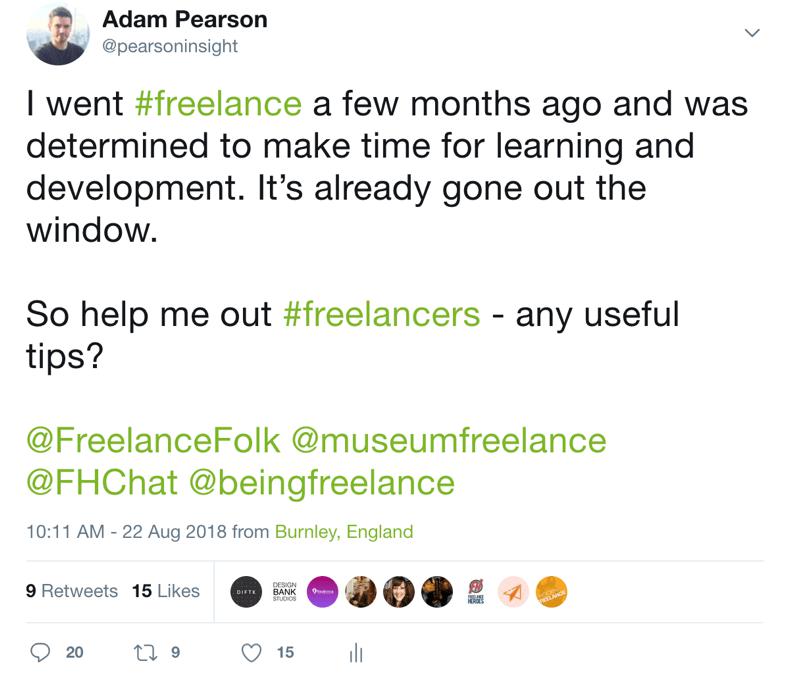
Image shows Adam’s tweet asking for freelancing tips.

A BLOG WHEN IT WAS JUST ADAM AND PEARSON INSIGHT

I was in the middle of another week which was running away from me. Filled with client work and business admin. But my own learning and development was nowhere to be seen.

I sent out a call for help on Twitter and LinkedIn to understand how other freelancers make time for their learning and development.

It will come as no surprise that the freelance community didn’t disappoint.

The response was so good it seemed a shame not to do something with them. So here is every reply and the 5 lessons I’ve taken away. 

1. Find ways to make the time

Everyone has their own approach to making time, whether that’s blocking a day out, getting up early, chunking up their day or making the most of travel time.

And it’s not just about finding the time, it’s how you prioritise and justify it alongside your other tasks too. You might need to treat it like client work, give it the place it deserves on your to do list or simply recognise that you’ve earned the time to work on yourself.

As Matthew and Cat point out, everyone’s different so find something that works for you.

Here’s what people said:

  • @beingfreelance: It’s a tricky one but treating your own stuff (be it side projects, self dev, admin, fitness) as if it were a client project may work – schedule it in, give it a deadline – could make you more likely to stick to it.
  • @davidjburnell: We often think of learning and reflection as ‘luxuries’. They are essentials. I schedule a slot every Friday afternoon, my ‘10% time’ and do my best to protect it. I figure by that stage of the week, if it is indeed a luxury, I’ve earned it.
  • @websmyth: It’s so hard to balance this one. I’ve just started marking out half a day a week to try and do this. Doesn’t always happen but attempting to set aside that time seems to help me actually get some self-development stuff done.
  • @GoodandWellUK: I use travel time for my own projects – especially if I’m working on a client site for the day. Amazing how efficient I can be when there’s only finite time available!
  • @pwaring: I put aside a day a week, usually a Wednesday, for doing non-work stuff (for me that’s a combination of learning new things and meeting friends for lunch). If you can resist the temptation to book work that day then it can work.
  • @deanwronowski: I always get up hour or so before 9 o’clock kicks in so I can work on my side projects. Now some of my side projects are being used by my clients so I can now work on them during the day 
  • @garden_lass: You have to keep a diary and make time for yourself! I’ve finished 3 courses and am half way through Project Management course since start of January this year!
  • @Katyx: Would you (back when it mattered) employ someone who had not updated their skills in years? If not, why would people invest in you? Stop writing IOU’s for learning and development and just do it.
  • Matthew Mountain: Space your day out into three. Pick what you need to do within those three slots. Learning for me is normally best in my personal time during a quiet evening. Do what suits you though, it is different for everyone.
  • Jennifer Powis: I find if I make a to do list and keep it in front of me, it really helps me to make time in my day for training.
  • Jason Trotter: Good luck, been 2 years now and there are still things on my to do list from when I started. If you are good and can adhere to time boxed schedule then you should be able to plan it in but I am terrible at following a plan as I have so much other demands for my attention from family, clients, business admin.
  • Cat Fyson: I totally understand! Try and use calendar blocking to manage your time and add a block of time dedicated to L&D – maybe it’s a Friday afternoon for a few hours, or at the beginning of the week…whatever works best for you.
  • Liz Elson: To work as a freelancer takes a lot of self-discipline and control. There are times when you feel very isolated and lonely. At the beginning I struggled a lot with time planning but once I learned it everything changed magically. I am now more productive and have time for the gym, development and learning. Plan your time wisely and always include breaks for the rest, sports and self-development.

Image shows a person in a library.

Photo by Victoria Kure-Wu on Unsplash

2. Find the type of learning that works for you

You need to find the time. But we’re all different so it’s also about the type of learning that works for you.

So it might be more group learning that’s harder to miss, online courses that you can fit around client work and life, or podcasts and audiobooks that you can digest on the go.

For what it’s worth, I definitely agree about podcasts. There’s some great stuff out there which I would put in the freelancer’s comfort blanket category. Being Freelance is a brilliant podcast featuring different freelancers who share their story. I’ve been working my way through the back catalogue and there’s always been something to take away from each episode. Steve also has an excellent weekly vlog. And Ben Capper’s ‘how to go freelance: a guide for the terrified’ is a reassuring listen for any new starters as he speaks to other freelancers about their experiences.

Here’s what people said:

  • @raisingginger: I find I reflect and learn the most in discussion with or listening to the experiences of others. So I make time for key conferences, network meet ups and informal catch-ups with peers. Once in the diary they’re harder to skip than solo CPD time…
  • Helen Griggs: I have the same challenge! I find podcasts are a good way to keep up to date and learn something, and it’s great that you can be multitasking while listening! I also try and identify 1 or 2 specific areas I want to develop so I have a focus. Setting a goal helps give you something tangible to aim for and by a specific date. It’s hard for it not to all go to pot when things get busy though!
  • @MDInc_NY: We suggest classes from Udemy – you can learn and expand quickly with readable online courses. #yougotthis
  • @AnywheresC: How to structure your day, week, and year are the challenges of also managing workload, output, and leads when freelance or self-employed but the #gtd #weeklyreview from Dave Allen @gtdguy helps me to balance my focus.
  • Kerry Grady: Audible. Listen to books and courses all day long. Most of the industry leaders will have a podcast too – easy listening, easy learning.

3. Recognise the importance of learning to your client work

It seems pretty obvious, but as a freelancer you are your business. To a greater or lesser extent, you are the product. Your development isn’t just for you, it’s for your clients.

You can’t afford to fall behind the curve, as Lee points out.

Here’s what people said:

  • @divedeepdevp: Yes, this is one very close to my heart. My L&D goes in the diary like any other meeting/project so I stick to it. I also consider it part of my activity that helps me add value to clients (not distracting from it) and makes me more marketable.
  • @simonperks: I make sure I set aside a couple of hours a week to read things relevant to the sectors with which I work, e.g. journal articles, analysis pieces, new books. Helps me to stay up to date and to know what my clients might be worrying about.
  • Lee Webber: schedule time in your calendar each week, it only has to be an hour – to keep your skills up to date with the ever-changing technology, new features or whatever is your specialism, else you will fall behind the curve.

4. Understand why you’re not finding the time for learning

Even when we block out the time, keeping it clear is easier said than done. It’s definitely made me reflect on how I run my one-person business and why I’m not finding the time. I’ve also started using Toggl to log my time. It’s a real eye-opener.

Here’s what people said:

  • @freelancefndn: This often means you’re not charging enough, because you don’t feel you can take the time ‘off.’ If it’s about prioritizing time and not the money, then it could be about a disconnect between the effort and the outcome.
  • @thescopeblog_: The first year of freelancing is the most difficult, especially when it comes to managing your own time. Have you considered logging your hours to see where you are overspending time? Good to have client work but even more important to find balance and ways to advance.

5. Finding time for learning is important, but don’t overdo it

It’s all a bit of a balancing act, really. As a few people pointed out, there’s got to be some down time too. So as important as learning and development is, it’s not going to be much use if you burn yourself out in pursuit of it.

Here’s what people said:

  • @LKB_PR: Set your intentions early because burn out is not sexy. I see a coach at least once a month to work on me and factor in ‘off’ time too.
  • @FreddyCryptuger: Don’t forget about rest, never work 7 days in a week.
  • Rebekka Arnold: Always have Sunday’s off, that’s something I made sure of, I work extra hard one day of the week to make sure I don’t have to sit at my desk on a Sunday! Plan your week in advance know what you’re doing every day and stick to a schedule! Don’t bite off more than you can chew either, quality is better than quantity always!

(Ironically, I’m writing this blog on a Sunday. But my wife’s out, I knocked off early on Friday while the sun was shining, so it’s all good.)

Image shows Adam’s dogs:  Freg & George.

These guys never forget to rest.

So, what’s changed for me?

I sent that tweet about 6 weeks ago. I’ve taken it all in. It’s important to listen and learn from others. But you’ve also got to listen to yourself. Everyone is different.

I know how I work, and I’d struggle to break off for learning and development during the week. So my approach now is a combination of:

Formal learning that I’ve paid for.

When I’ve paid for something, I want to get value out of it. Maybe it’s the tight northerner in me. Weekly online tutorials, ‘homework’ and assignment deadlines provide the ongoing accountability. And I know there’s a benefit to me, my business and my clients at the end of it through industry accreditation and knowledge, so there’s a reason to prioritise it.

Blocking out big chunks of time to learn things that will really add to my business offer.

I’m taking 3 weeks ‘off’ around Christmas. No client work, even if it means turning work down. I’ll have some well-deserved festive downtime, I’ll spend some time reflecting on my first 6 months as a freelancer and I’ll dedicate at least a week to learning some new skills I know will be valued by clients. And it means between now and then I don’t need to beat myself up about not fitting it in around client work.

Valuable meet ups and catch ups.

They go in the diary, I won’t let people down and I get a lot out of them. I nicked an idea from Marge Ainsley about aiming to meet someone new each week. For me networking isn’t about how many business cards you can collect at an event, but how many new relationships you can build with like-minded people. These are people you can work and collaborate with, turn to and rely on for advice and support, and share ideas and learning with.

Making the most of the online freelance community.

There’s so much good stuff out there. Individual freelancers sharing really useful blogs and articles. Conversations and threads on social media. And dedicated networks run by freelancers going above and beyond to foster a supportive virtual community. Shout out to Freelance Heroes, Being Freelance (again) and Museum Freelance (and there are many more).

So thank you to everyone who took the time to reply with tips on learning and development. They’ve really helped me, and I hope they’re useful to other freelancers too.